

In an effort to improve dust collection systems, leaders in the wood industry have dedicated a great deal of time and resources to improving dust extraction efficiency in wordworking plants.
In recent years tooling and aggregate manufactures have expanded their product lines to include dust extraction fans designed for CNC routers. Machine manufactures are designing moulders and planers with dust extraction performance as a priority. All these innovations are driven by the necessity to provide a safer cleaner and more productive working environment for employee and improve overall production efficiency.
The emergence of ‘nested based’ machines has dramatically improved machining efficiency, but has also presented a challenge from a waste material perspective. Board material that was previously cut with a 1/8 wide blade is now being machined with 3/8 or ó diameter tools, dramatically increasing the volume of dust created during the machining process, resulting a number of negative impacts.
Excessive amounts of waste material surrounding the cutting tool increases heat generation, causing reduced tool life and overall reduction in quality and efficiency of the machine. Manual labor is inevitably increased as the operators spend time blowing off router tables and cleaning floors and other surfaces in close proximity to the machine. And health and safety concerns are amplified as airborne dust particulate levels increase.
Machine manufactures have addressed the problem with improved infeed and outfeed vacuum systems and several tooling manufactures have developed ‘dust extraction fans’ to help lift waste material from the cutting surface.
Dust Extraction Fans: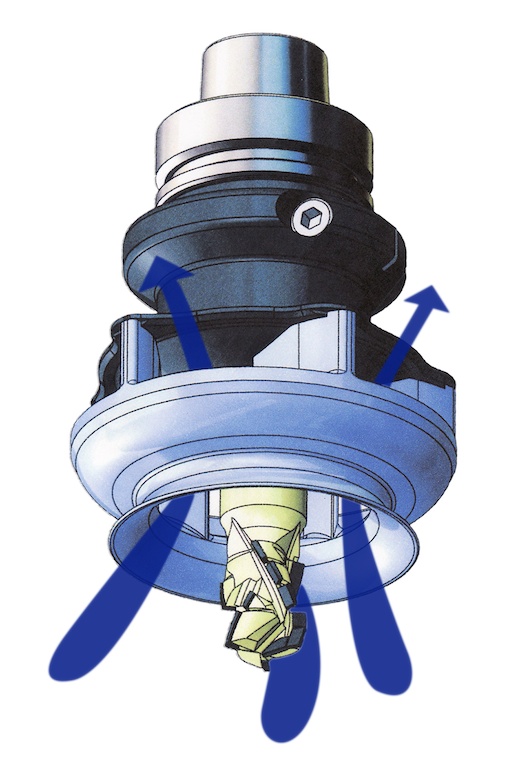

The extraction devices vary in design and performance; however the basic function is similar. A lightweight fan mounted to a tool holder surrounds the cutting tool in very close proximity to the material being machined. When the machine spindle reaches a set RPM, a vacuum is created around the cutting tool which forces material upward and off the machine table and into the machine dust extraction system. It is important to note that these systems are designed as ‘vacuum assist devices’ for the existing machine dust collection system and will not perform properly unless the existing machine system has at least 3000 to 6000 CFM at the dust hood location. Since vacuum is heavily dependent on air volume and direction of flow, other machine factors such as hood size, location of guarding and dust skirts will affect the performance of the entire system. It is absolutely imperative that any fan devices be ‘dynamically balanced’ to proper RPM to ensure safety and optimal performance of machine and tool. The fans must also remain clean of pitch, dust and large chips to ensure a safe operating balance. If excessive vibration or sound is made by any fan system, return unit to your supplier immediately for balance verification based on operating RPM.
Other factors such as RPM, feed speed, depth of cut and material density will inevitably affect fan performance. Consult your tooling/fan supplier for support and recommendations based on the application.
Tool Body Design:
The fan systems described above are sufficient for smaller diameter tooling (2 inch and under) but how can we improve dust extraction with ‘larger tooling’ that will not fit inside a fan system.
The answer lies in the design of the tool body. Custom tool manufactures have the capabilities to engineer tool bodies to hold the cutting edges and act as a fan to create upward pressure inside the dust hood of the machine. Other variations of tools with ‘fan characteristics’ can be engineers by tool companies with advanced custom manufacturing capabilities.
It has been said that ‘necessity is the mother of invention’ and the necessity to decrease dust is evident throughout the wood industry. But we must be mindful that one company rarely achieves solutions independently. The tooling/fan solutions described in this document are merely a piece of the puzzle. More often, collaboration between machine, tooling and material companies will yield the best results and innovations for your company.
Scott Burton is the Sales and Marketing Manager for Royce//Ayr Cutting Tools.
He can be reached at sburton@royceayr.com