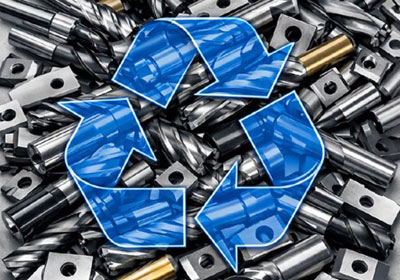
For many Canadian woodworking companies, tooling costs have always been treated as a necessary expense without thought of cost recovery by recycling. Carbide inserts and router bits are wear parts that are consumed, replaced and quietly written off.
But today’s market conditions demand a shift in thinking. Scrap carbide is no longer waste. It is a recoverable asset that can deliver a meaningful, recurring financial return when managed properly.
Why Carbide Scrap
Is So Valuable Today
The value of carbide scrap is being driven by an extraordinary convergence of global forces centered on tungsten, the critical raw material in tungsten carbide tooling.
Since 2025, tungsten markets have experienced dramatic volatility and sustained price increases. In some cases, benchmark tungsten products have risen by over 300% year-to-date and as much as 900% over a 12-month period. At the same time, tungsten powder and carbide input materials have seen price increases exceeding 200% in a single year.
The reasons are structural,
not temporary:
Extreme supply concentration: China controls roughly 70–80% of global tungsten production and processing
Mining constraints: Declining ore grades and tightening environmental regulations have reduced output
Export controls and geopolitics: Restrictions and licensing changes have disrupted global supply chains
Surging demand: Aerospace, defense, EVs, and high-tech manufacturing are consuming increasing volumes
Shipping Cost: More recently increased shipping cost has applied upward pressures on cost per unit
The net result is a volatile supply chain with no market correction in sight. Carbide is no longer cheap, stable, or easily replaceable so recycling is the only mechanism to offset price increases of new tools.
Canada’s carbide supply situation is particularly exposed. Domestic production is limited, meaning most carbide tooling is imported. Prices in Canada remain elevated due to transportation costs, currency effects, and reliance on global supply chains.
At the shop-floor level, this shows up in very practical ways:
More frequent price increases from tooling suppliers
Reduced availability or longer lead times for specialty tooling
Tightening margins on production work
Increased pressure to maximize tool life and recovery
Simply put, every carbide insert, tipped blade, or worn router bit represents embodied value that is increasingly expensive to replace.
Scrap as a Revenue Stream
Many woodworking operations still underestimate how valuable carbide scrap has become. As of 2026, typical Canadian scrap carbide prices fall into the following ranges:
Clean solid carbide (drills, rods, blanks): $40–$50 per lb
Inserts and tooling: $–$16 per lb
Carbide-tipped tools (on steel):
$6–$15 per lb
Mixed or unsorted material: $3–$8 per lb
In some markets, premium grades have averaged $50–$60.00 per lb in early 2026.
To put this into perspective: Carbide scrap can be worth five to10 times more per pound than copper or brass, making it one of the most valuable materials in a typical woodworking facility’s waste stream.
Even modest accumulation can translate into real dollars. A mid-sized shop generating 200–500 lbs of scrap carbide annually could recover several thousand dollars per year—money that would otherwise be lost.
Supply Pressure Is Making
Scrap Even More Strategic
Beyond immediate cash recovery, carbide recycling is becoming strategically important.
Because primary tungsten supply is constrained, recycled carbide has become a critical secondary feedstock for tool manufacturers. In fact, scrap carbide is now often the fastest way to reintroduce tungsten back into the supply chain and its value tends to rise faster than newly mined material during supply shortages.
This has two implications for Canadian woodworking companies:
Scrap values are likely to remain strong or increase
Recycling contributes directly to stabilizing the tooling supply chain
In a tightening market, shops that systematically recover carbide are effectively participating in the same supply loop that feeds their future tooling.
Best Practices for Maximizing Scrap Value
To unlock the full financial benefit, woodworking companies need to treat carbide recycling as a managed process as follows:
1. Segregate materials at the source
Separate carbide from steel, aluminum, and general scrap. Mixed bins significantly reduce value. Clean, high-grade material commands premium pricing.
2. Sort by type where practical
If volumes justify it, separate:
Inserts and indexable tooling
Solid carbide (drills, blanks, end mills)
Carbide-tipped tools
Even basic sorting can improve returns by several dollars per pound.
3. Remove contaminants
Oil, dirt, and excessive steel attachment lower the payout. While brazed carbide will still sell, cleaner material receives better pricing.
4. Store securely and
accumulate volume
Carbide is dense and valuable. Centralized, labeled containers reduce loss and simplify periodic sales.
5. Build relationships with dedicated carbide recyclers
Specialized buyers often pay higher rates than general scrap yards and may provide:
Pickup programs
Locked collection bins
Transparent pricing tied to tungsten markets
From Waste to
Competitive Advantage
In today’s environment, carbide recycling should be viewed through the same lens as yield improvement, tool life optimization, or material cost control.
The economic case is clear:
Scrap carbide commands
$10–$50 per lb in Canada today depending on grade
Prices have risen significantly in tandem with global tungsten shortages
Supply conditions suggest continued volatility and upward pressure
For Canadian woodworking companies under unprecedented pressures, carbide recycling is a small win but significant enough to make the effort. Companies that formalize their carbide recycling practices will not only reduce waste, they will generate cash flow, offset tooling costs, and position themselves more resiliently in a tightening global materials market. In a time when margins are under pressure and supply chains are unpredictable, consider a recycling plan.