
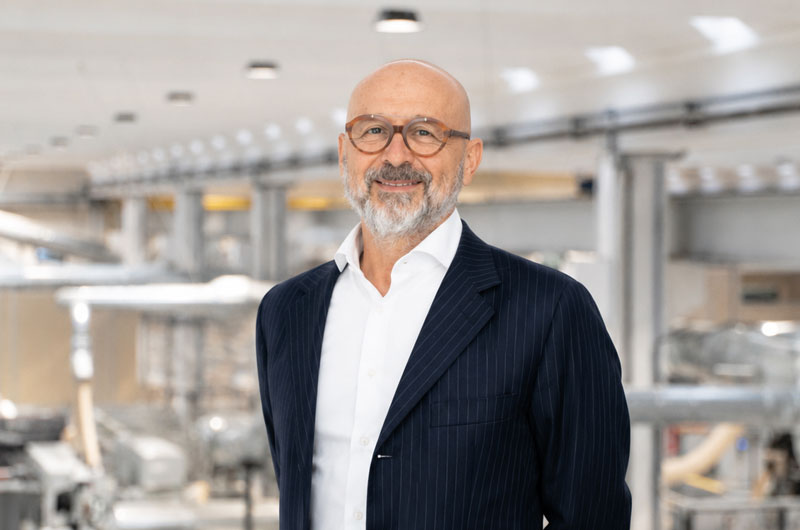
Roberto Selci
Biesse CEO Roberto Selci outlines a strategy built on technology, AI and customer-focused solutions, while Biesse Canada prepares to bring scalable automation and new software to Canadian manufacturers.
Biesse Group is embarking on a transformation that puts product innovation, digital technology and integrated production solutions at the centre of its growth strategy.
CEO Roberto Selci believes the company must move beyond competing on machinery alone to deliver solutions that help customers improve productivity, connect their operations and build more flexible manufacturing environments.
In a recent interview with Woodworking, Selci said the strategy is designed to increase Biesse’s revenues significantly while lifting profitability margins above 6.5 per cent.
Founded by Selci’s father in 1969, Biesse has grown into a global manufacturer of machinery and components for processing wood, glass, stone and advanced materials. With operations spanning multiple markets and approximately 20 subsidiaries worldwide, the company has an established international presence. Selci’s challenge now is to adapt that business to a market in which technological differentiation and customer value are becoming increasingly important.
“We are investing a lot in technology because, as I used to say, today, the machine and woodworking industries have become a commodity,” Selci said.
He identified Chinese manufacturers as a significant competitive challenge, pointing to government support and a substantial contraction in their domestic market. Selci estimated that the Chinese market had shrunk by 30 to 35 per cent, prompting manufacturers to sell internationally at what he described as dumping prices, supported by government measures intended to maintain employment.
The result, he said, is an increasingly price-driven competitive environment that Biesse cannot change on its own.
“We cannot stop it, and we need to start to invest a lot in innovation,” he said.
For Selci, the answer is to differentiate Biesse’s products and services through greater technological capability, rather than compete solely on price. The company’s strategy for the next three to five years centres on research, talent development and increased technological content across its product portfolio.
The approach extends beyond woodworking machinery to Biesse’s operations in glass and stone processing, where Selci sees the same need to adapt to changing customer expectations and competitive pressures.
From machinery supplier to production partner
A central element of Biesse’s transformation is a shift in how the company approaches its customers. Rather than beginning a sales conversation with an individual machine, Selci wants the company to focus on the customer’s broader production requirements.
“If we start to talk only about the machine, the battle is 80 per cent lost,” he said.
Instead, Biesse needs to demonstrate how its technology can help organize a factory, connect processes and establish a production environment that is efficient, reliable and capable of expanding as a business grows.
“We must show you how I can put order in your factory, and then we will talk about the machines,” he said.
That means understanding how equipment works together, how production flows through a facility and how a customer can build a system that remains useful as requirements evolve. The objective is to deliver processes that are solid, simple and scalable, rather than simply supply a piece of equipment.
Selci also sees customer education as an essential part of that change. Manufacturers need to understand that automation and advanced technology are not necessarily beyond their budgets or capabilities.
Technology, he said, has become more accessible than it was 20 years ago. Suppliers therefore have a responsibility to help customers understand the available options, overcome concerns about complexity and recognize the potential benefits of modern production systems.
For Biesse, this more consultative approach is also a way to establish longer-term customer relationships and distinguish itself from competitors focused primarily on machine pricing.
Digital technology and AI take centre stage
Digitalization is another major component of the strategy. Biesse wants its machines to become part of a connected production environment in which software, data and equipment work together across the factory.
“Today, we can manage our machines and our competitor’s,” Selci said, referring to the ability to integrate equipment from different manufacturers.
That capability is important for manufacturers that operate mixed production lines, where machines from several suppliers must communicate and work together. Rather than requiring customers to build their operations around one manufacturer’s equipment, Biesse aims to help coordinate machinery and processes across the wider production environment.
The company is developing this ecosystem through B/On and its acquisition of Orchestra, with the aim of connecting machinery, software and data while strengthening customer support and service offerings.
Selci said Biesse also plans to invest heavily in artificial intelligence, viewing it as another means of delivering greater value to customers and differentiating the company in an increasingly competitive global market.
The ambition is to move beyond the traditional transaction of selling a machine and instead help manage how that machine interacts with the customer’s entire production system. In doing so, Biesse hopes to create a more continuous relationship with customers, supported by software, technical assistance and services throughout the life of their operations.

Greg Guleserian
Biesse Canada brings scalable automation to the market
The strategy is already beginning to take shape in North America, where Biesse Canada is preparing to demonstrate how automation and integrated software can serve manufacturers of different sizes.
Biesse Canada CEO Greg Guleserian said the company remains committed to the Canadian market despite the economic uncertainty and other challenges facing the country.
He emphasized that Biesse continues to invest in Canada, its customers and its local capabilities. A key part of that commitment will be showcased at the company's Toronto showroom during Woodworking Technology Days (WTD).
Guleserian said Biesse has developed a new presentation for the event, featuring automated solutions designed not only for large manufacturers but also for small and medium-sized businesses.
“We're going to be introducing automated solutions not only for big customer, but the modular system that can go for a smaller and medium customers that's completely scalable,” he said.
The demonstration will include an automated line being introduced this year, alongside solutions intended to make integrated production more accessible to businesses that may not have the scale or resources to justify a large, fully customized system.
“The idea is that it's no longer like the past, where only big, big, big customers can afford or need such systems. Everybody does,” Guleserian said.
The emphasis on modularity reflects a broader change in the economics and expectations surrounding automation. Smaller manufacturers increasingly need to improve efficiency and consistency, but they also need to manage capital spending carefully and avoid investing in systems that cannot accommodate future growth.
A scalable production line offers a potential way forward, allowing a business to start with a system suited to its current requirements and expand as production volumes and operational needs increase.
For Guleserian, the value lies not simply in connecting machines but in ensuring the entire line is configured around the customer's needs.
“It's very important to optimize your line,” he said. “It's very important to understand that machine A, B, C and D not only have to handshake with each other, but also be optimized for the customer's needs.”
The ability to scale is equally important. Manufacturers need confidence that an initial investment can form the foundation of a larger system, rather than become obsolete when the business expands.
Service is part of the offering
Alongside automation and software, Biesse Canada is also strengthening its service capabilities as part of its broader effort to provide customers with a more complete solution.
Guleserian said the company has introduced a new customer program that guarantees a response time, backed by defined commitments and penalties if Biesse fails to meet them.
“We've also introduced a new program for our customers where we guarantee them a response time, something that no other competition does, and that program has already started,” he said.
For manufacturers investing in automated production, service reliability can be as important as the machinery itself. A highly integrated line can deliver productivity benefits, but unexpected downtime can also affect multiple stages of production. Clear service commitments therefore become an important part of the overall investment.
The initiative aligns with Selci's wider strategy of moving away from a product-only sales model and toward a relationship built around performance, support and long-term customer requirements.
New software aims to simplify factory integration
Biesse Canada also plans to introduce its latest software solution at Woodworking Technology Days, which Guleserian described as a potential game changer for manufacturers seeking greater control over their operations.
The software is intended to simplify the management and integration of multiple machines, allowing customers to bring equipment and production information together within a common software environment.
According to Guleserian, the system is being designed to reduce the need for specialist engineering expertise to navigate and manage the integration process. It will also support operations spanning an entire factory or multiple manufacturing sites.
The potential audience extends beyond large industrial companies. Smaller, family-owned businesses looking to expand, mid-sized manufacturers and companies operating several facilities could all benefit from a more accessible approach to production management.
For these businesses, the ability to connect equipment and coordinate processes without introducing unnecessary complexity could make digital integration a more practical investment.
The software launch also reflects the direction outlined by Selci: Machinery, digital systems and services must work together to provide value that extends beyond the capabilities of any individual machine.
A broader vision for the future of manufacturing
Biesse's transformation rests on a clear proposition: Competing in a global market increasingly driven by price requires more than incremental improvements to machinery.
Selci wants the company to differentiate itself through innovation, artificial intelligence, connected production systems and a stronger emphasis on customer education. In Canada, Guleserian is translating that vision into a more immediate offering built around scalable automation, accessible software integration and measurable service commitments.
Together, the initiatives point toward a model in which manufacturers can adopt technology in stages, connect equipment from different suppliers and expand their production capabilities without having to redesign their operations from scratch.
For Biesse, the opportunity is to become more than a machinery supplier. By helping customers plan, connect and optimize their factories, the company aims to build lasting relationships while creating new avenues for revenue growth and improved profitability.
As Selci sees it, the next phase of competition will be determined not simply by who can sell a machine at the lowest price, but by who can help customers build a better production system for the future.