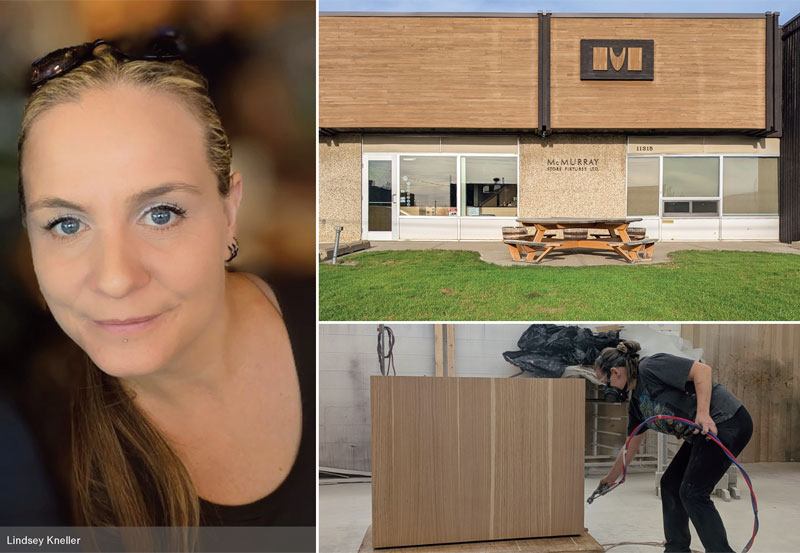
Lindsey Kneller
FEATURE - WOMEN IN THE INDUSTRY
The first thing people notice about the shop is the noise.
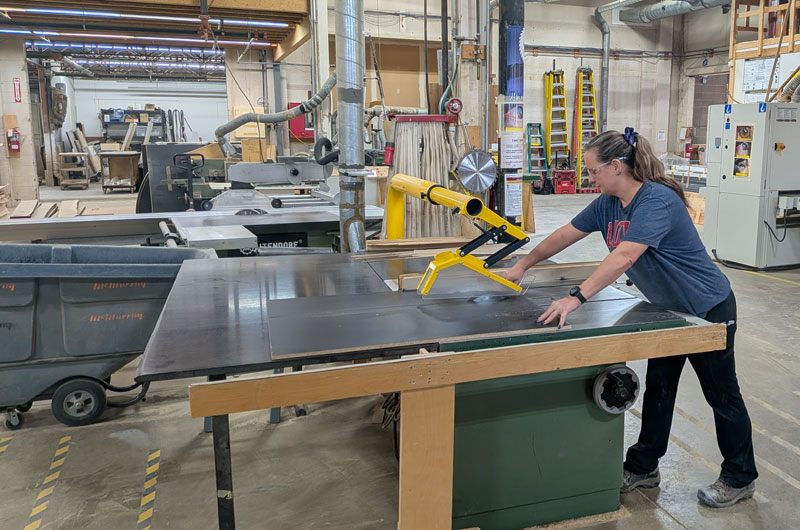
The whine of saw blades biting into plywood. The hiss of spray guns in the paint booth. Forklifts backing across concrete floors. Men hauling sheets, cabinets, desks, and doors through a 26,000-square-foot maze of sawdust and deadlines.
The second thing they notice—if they’re paying attention—is Lindsey Kneller standing in the middle of it all.
Not behind a desk. Not hidden in an office.
On the floor.
One eye on shipping schedules, another on production, answering questions from co-workers. Somebody needs help in finishing. Somebody else is waiting on materials. A truck is late. A project is behind schedule. A crew needs direction.
And somehow, Kneller keeps the whole thing moving.
Three years ago, she became shop foreman at McMurray Interiors in Edmonton, Alberta, overseeing nearly 30 shop workers and helping lead commercial projects across the province—schools, hospitals, office towers, recreation centers.
She never planned for any of it.
Growing up in the tiny community of Rolly View, just south of Edmonton, Kneller thought she’d become a phys-ed teacher. But small-town schools didn’t offer many options, and she didn’t have the courses she needed. What she did have was shop class.
“I developed a liking for building furniture,” she says. “And I was actually pretty good at it.”
Her uncle was a cabinetmaker. Her mother encouraged her to try the trade. So before graduating high school, Kneller started searching for work.
Most places weren’t hiring apprentices.
Then somebody pointed her toward McMurray Interiors.
Two weeks after graduation, she walked into the shop for the first time.
“The rest is history,” she says.
At first, she did a little bit of everything. Laminating. Cabinet building. Running machinery. Finishing work. Whatever needed doing.
But nothing was handed to her.
Woodworking shops were—and still are—largely male worlds. Women make up only a small percentage of trades like cabinetmaking and carpentry and when Kneller started, the atmosphere could be rough.
“You needed thick skin,” she says.
There were comments. Doubts. People wondering whether a small-framed young woman belonged in a cabinet shop at all.
But Kneller learned quickly that surviving in the trades wasn’t about pretending things were easy. It was about refusing to quit when they weren’t.
If somebody doubted she could carry a sheet of plywood, she learned how to carry one. If a task seemed too physical, she figured out the mechanics of it—how to use leverage, how to move smarter, how to let tools and technique reduce strain on the body.
“You can’t let anybody beat you down and tell you that you can’t do it,” she says. “Because you probably can.”
More importantly, McMurray Interiors’ owners were fantastic. Not only did they offer her an apprenticeship, they also supported her every step of the way. And she found mentors.
Wayne Allen taught her the craft. Elmer Shupeina, the shop foreman at the time, taught her leadership.
“He took me under his wing,” Kneller says. “He encouraged me to think for myself.”
Elmer gave her responsibility early—making her lead hand on important jobs, trusting her judgment, pushing her to solve problems instead of waiting for instructions.
That trust changed everything.
Eventually, Kneller found her niche in the finishing department.
To some people, finishing work is repetitive: Sanding, staining, spraying, coating. But to Kneller, it was where craftsmanship became visible. A perfect cabinet could be ruined by a poor finish. Customers didn’t see the joinery inside the wood—they saw the surface.
And finishing, she discovered, was never really repetitive at all.
Every custom project brought new colours, textures, materials, and challenges. Sometimes clients wanted finishes the team had never attempted before.
“They’d throw a finish at us and say, ‘Figure it out,’” Kneller recalls.
So she did.
For nearly 20 years, she thrived on the pressure of the paint department, where projects arrived late and deadlines arrived early. She became known as someone who stayed calm under stress and found solutions instead of excuses.
Then COVID changed everything.
Workers left. Hiring slowed. Departments became short-staffed. One day the company needed help in shipping, and Kneller volunteered.
“I’m not busy in the paint department right now,” she told them. “I can help out.”
What began as temporary help turned into something bigger. She took on shipping responsibilities. Then oversight tasks. Then assistant foreman duties.
And when the foreman left a few months later, management asked her whether she wanted the position.
She hesitated.
“It is a huge stress to take on,” she says.
But deep down, she already knew the answer.
She was already doing the job.
“So I figured,” she says with a laugh, “‘I might as well take the title too.’”
Today, Kneller oversees the entire shop floor. She coordinates projects, mentors employees, assigns work, manages timelines, and helps keep production on budget. But she still refuses to lead from behind a desk.
“That’s just not my thing,” she says.
She prefers the floor. The noise. The movement. The people.
And she especially wants more women to see a future there too.
“We have a number of women in our shop,” she says proudly. “And I always encourage women to take on bigger roles.”
She knows the stereotypes still exist. People still look surprised when they learn the foreman is a woman. Some applicants still walk into the shop expecting only dust, brute strength and old-school attitudes.
But Kneller believes the industry is changing.
Slowly.
And she wants more women to help change it faster.
“Don’t judge a book by its cover,” she says. “Just because someone is female doesn’t mean they can’t do the job.”
The work is still physical. Much of it is still manual. At McMurray Interiors, workers still lift sheets onto saws by hand. Materials still get carried into job sites manually. The trade still demands endurance, problem-solving and a certain amount of grit.
But Kneller believes those jobs can be done by everyone—not just men.
“Most of the time, women can do anything a man can do,” she says.
She pauses for a moment before adding something important to her.
“Don’t get discouraged.”
Not if you need help lifting something. Not if the shop feels intimidating. Not if somebody doubts you. Not if you’re the only woman in the room.
Because somewhere between the noise of the saws and the pressure of deadlines, Kneller built something larger than a career.
She built proof.
Proof that leadership doesn’t have a gender.
Proof that skill matters more than stereotypes.
And proof that sometimes the people who never planned to lead are exactly the ones who should.